Restore. Revive.
Sustain.
Regenesis Solutions advises clients developing in locations of significant ecological value, where the question is not simply whether consent can be obtained but whether the proposal and the place can be made to work together over the long term. We provide realistic and honest appraisals and provide executable plans for the minimisation of development impacts and the long-term stewardship of developed locations in advance of project execution to support the obtaining of consents for responsible and sustainable development of all kinds in all settings.
Our approach
Where a scheme cannot be reconciled with its setting, we say so at a point when it can still be changed.
Our answer is evidence based and it is candid. More commonly, the analysis shows that impact is concentrated in a limited number of components, and that those components are seldom the principal drivers of value. That finding is what makes a workable revision possible.
The further opportunity lies in the operating phase. A development generates revenue over decades. Directing a defined share of it into an independently governed conservation fund establishes a durable source of stewardship funding, secured against the asset rather than dependent on the goodwill of successive owners. It delivers considerably more, and for considerably longer, than a single mitigation payment.
What we do
Ecological baseline
Establish the ecological baseline of the site, its need for preservation and its potential for environmental and biodiversity improvement, and determine the substance of the development which is being proposed and its potential risk to the host environmental, ecological and social ecosystem.
Natural capital accounts
Prepare Natural Capital Accounts for the host environment, to a standard recognised internationally by lenders and regulators.
Determining habitats and species
Identify the specific habitats and species that will be considerations and whose sustainable treatment will determine the outcome of an application for the proposed development.
Revised scheme
Assess impacts, determine responses to mitigate and develop a corresponding revised scheme designed around those factors and constraints and so capable of consent.
Conservation systems and finance
Determine a specific and executable plan of sustainable development, improvement and long-term management of the host locality and its social and environmental ecosystem and structure conservation finance mechanisms funded from a share of operating revenues, sponsorships and participations with other, established and funded conservation bodies.
Delivery programme
Set out the delivery programme: responsibilities, timescales, costs and monitoring for optimising the sustainability of development proposals, monitoring development implementation, measuring ongoing impacts and adjusting development methodology throughout and setting up, launching and operating an entity to act as long-term steward of the development locality with the objective of maintenance and continuous improvement of ecology and socio-economic ecosystems at the location.
Where we work

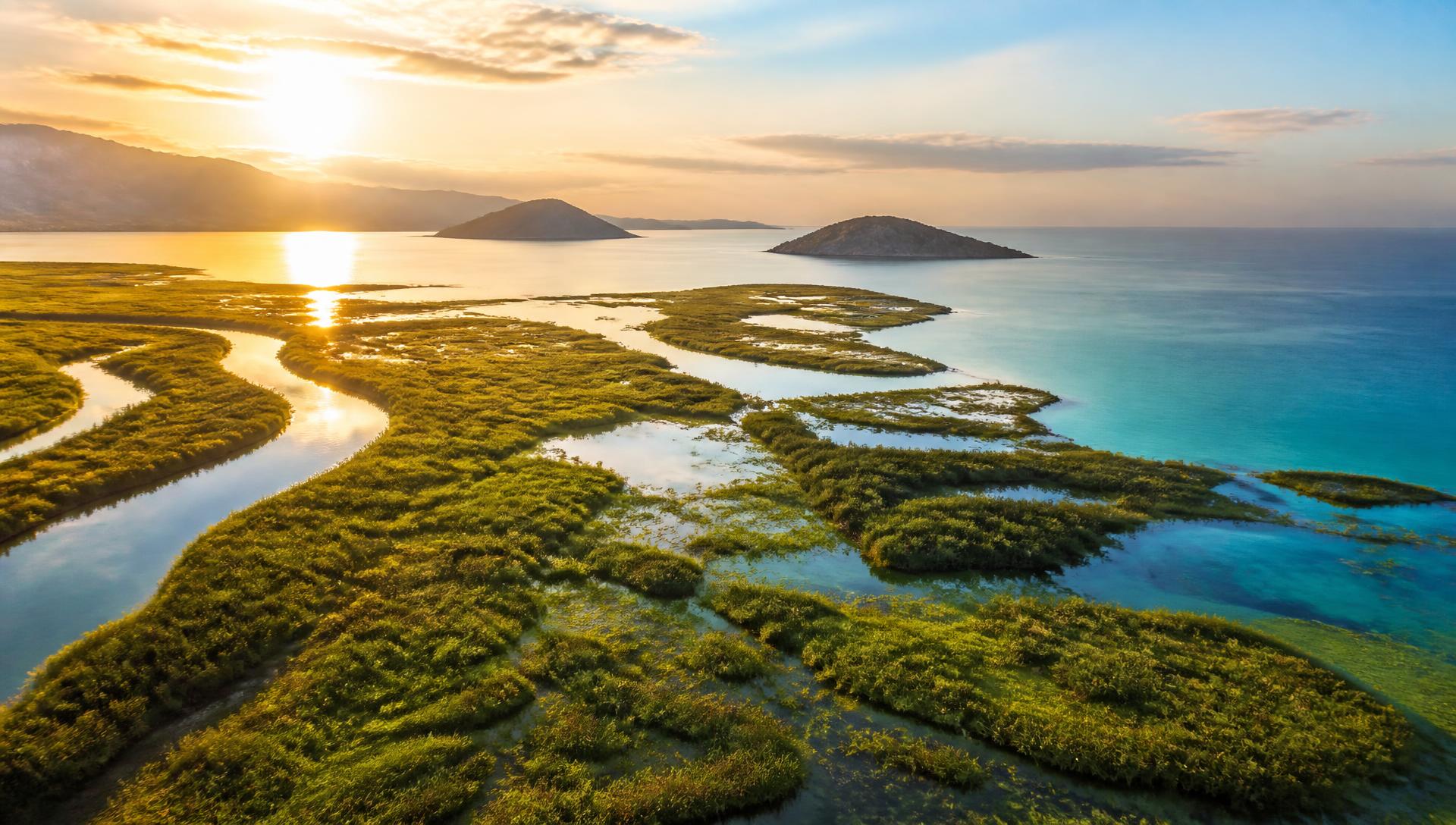
Coastal and marine protected areas, islands, river deltas and coastal wetlands, and designated landscapes subject to development pressure. Principally the Mediterranean and wider Europe.
How we work
We work from primary documents rather than secondary commentary.
We state explicitly what could not be established.
Where credible sources diverge, we present the range and explain the divergence.
We do not write to a predetermined conclusion.